Aluminum Checkered Plate For Stair Treads
Dec-18-2025
In the construction of stair treads in industrial plants, public venues and high-end residences, the choice of tread material directly affects safety performance and service life. Aluminium checkered plates, with their unique mechanical properties and processing advantages, have gradually replaced traditional steel and ordinary sheet metal, becoming the preferred material for stair treads. Based on our more than ten years of export processing experience, the core value of aluminum checkered plate for stairs always revolves around three dimensions: "slip resistance and reliability, lightweight, and corrosion and weather resistance."
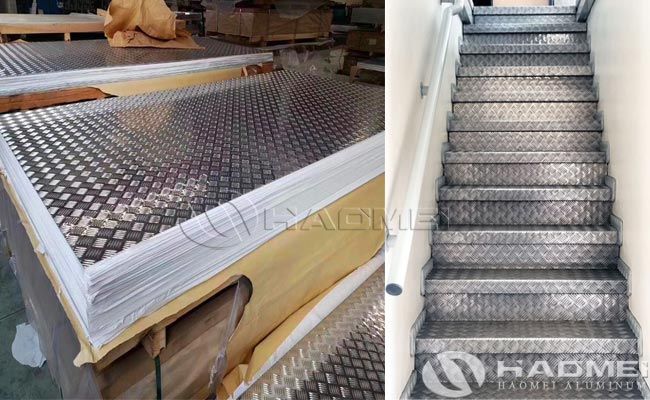
Slip resistance is a core indicator of stair tread performance. The structure of diamond pattern has been optimized through mechanical simulation, with the pattern height controlled between 1.2-1.8mm. This dimension ensures a sufficient coefficient of friction (≥0.85 in dry conditions and ≥0.6 in wet conditions) while avoiding cleaning dead zones. Actual tests show that under a load of 150kg, the sliding displacement of the tread surface is less than 0.3mm, far exceeding the 0.8mm limit in the standard. Specifically designed for humid environments such as food processing workshops and swimming pools, we can also customize a brushed surface combined with a patterned composite process to further enhance the anti-slip coefficient to over 0.9.
Regarding material strength, we prioritize 3003 and 5052 series aluminum alloy substrates. 3003 series aluminum checkered plates contain 1.0-1.5% manganese, with a tensile strength of up to 145MPa and a yield strength of 75MPa, suitable for general civilian and commercial applications. 5052 series aluminium checker plates contain 2.2-2.8% magnesium, increasing the tensile strength to 260MPa, meeting the demands of heavy-duty industrial environments, such as freight staircases in warehousing and logistics centers, which can withstand long-term forklift loads without deformation. All treads undergo heat treatment, achieving a 92% internal stress relief rate, effectively preventing warping and deformation after long-term use.
Lightweight design and corrosion resistance are significant advantages of aluminum checkered plate for stairs. For the same size treads, aluminum checker plates weigh only 35% of steel, making staircase structural load-bearing design more economical and improving installation efficiency by 40%. In weathering tests, after 2000 hours of neutral salt spray testing, the surface of the checker plate stair treads material showed no oxidation spots, and the corrosion rate was less than 0.002 mm/year, far exceeding the corrosion resistance requirements for building materials in coastal areas. The aquarium stair treads we customized for a Nordic client have been stably used for 6 years in a high-humidity salt spray environment, and the surface condition remains intact.
In terms of processing precision, the tread length tolerance is controlled within ±0.5 mm, and the diagonal deviation is ≤1 mm, ensuring a smooth splice. For different installation needs, M6-M10 threaded holes can be pre-fabricated with a hole position accuracy of ±0.2 mm, eliminating the need for on-site secondary processing. It is worth noting that our chromium-free passivation process not only complies with the EU RoHS directive but also achieves a paint film adhesion rating of 0, meeting the decorative requirements for long-term outdoor use.
As traditional materials gradually fade from the market due to insufficient durability or high maintenance costs, aluminum checkered plate, with their superior durability, lightweight, and low maintenance costs, are becoming the preferred material for high-end staircase projects.
Aluminum checkered plates for stair treads are widely used in high-end staircase projects and other architectural decoration fields, including:
Commercial buildings: such as stair treads in shopping malls, hotels, and office buildings, providing safe and aesthetically pleasing passageways.
Public facilities: such as train stations, airports, and other high-traffic areas, capable of withstanding significant usage pressure.
Residential buildings: In modern residences, aluminum checker plates are not only used as stair treads but also in balconies, corridors, and other areas.